Debug EV Charging Communication Failures in Minutes, Not Hours
Instantly identify the root cause of failed sessions, attribute faults to the EV or EVSE, and get automated proof of DIN 70121 & ISO 15118 requirement violations. No more manual pcap traces analysis or searching through the standards.
The Charging Interoperability Challenge
Why senior engineers are stuck analyzing traces instead of building features.
The Protocol Complexity
As we transition from the simplicity of DIN 70121 and AC-PWM to ISO 15118-2 and ISO 15118-20, the complexity of a single charging session has increased exponentially, and the test matrix has grown from a few scenarios to thousands.
Modern chargers and vehicles must now handle legacy DIN, modern ISO-2, and next-gen ISO-20 implementations simultaneously. This mix of different protocols and strict TLS 1.2/1.3 security requirements creates a fragile ecosystem where EVs and EVSEs often fail to charge due to subtle mismatches and different interpretations of the standards.
The Manual Analysis Bottleneck
Wireshark is the industry standard for network analysis, but it wasn't built for the complex state machines and requirements of ISO 15118. Even with decryption and dissectors, engineers are still left staring at hundreds of lines of packet logs.
The real challenge isn't seeing the data, it's determining why a session failed. Senior talent shouldn't waste hours manually correlating timestamps, searching through PDF standards to verify timeout limits, and validating sequence logic. That is work a dedicated tool should do instantly.
The "Blame Game" & AFIR Mandate
When a charging session fails in the field, a costly deadlock begins: the EVSE vendor points at the vehicle, and the OEM points at the charger. With the AFIR mandate for ISO 15118-2 now in full effect as of January 2026, there is no more room for uncertainty.
Without an objective, standard-based referee to prove exactly where the sequence broke, resolving a single issue can take weeks of finger-pointing. As the ISO 15118-20 AFIR deadline next year approaches, these unresolved issues quickly turn into expensive field failures that hurt your field reliability and brand reputation.
The Solution: Expert-in-a-Box Analysis
The KERNVIA Charging Communication Analyzer is a desktop software tool that parses your communication traces (.pcap, .pcapng, .dump) between an electric vehicle (EV) and a charging station (EVSE), automatically validating them against strict DIN 70121 and ISO 15118 rule sets. It inspects every layer of the communication, from SLAC and TCP to TLS and the V2G Application layer, to detect deviations from the standards, including sequence errors, timing deviations, security issues, and much more. The tool pinpoints the exact root cause of failed sessions and provides a clear, plain-English explanation, eliminating the need for manual analysis.
Intuitive Sequence Visualization
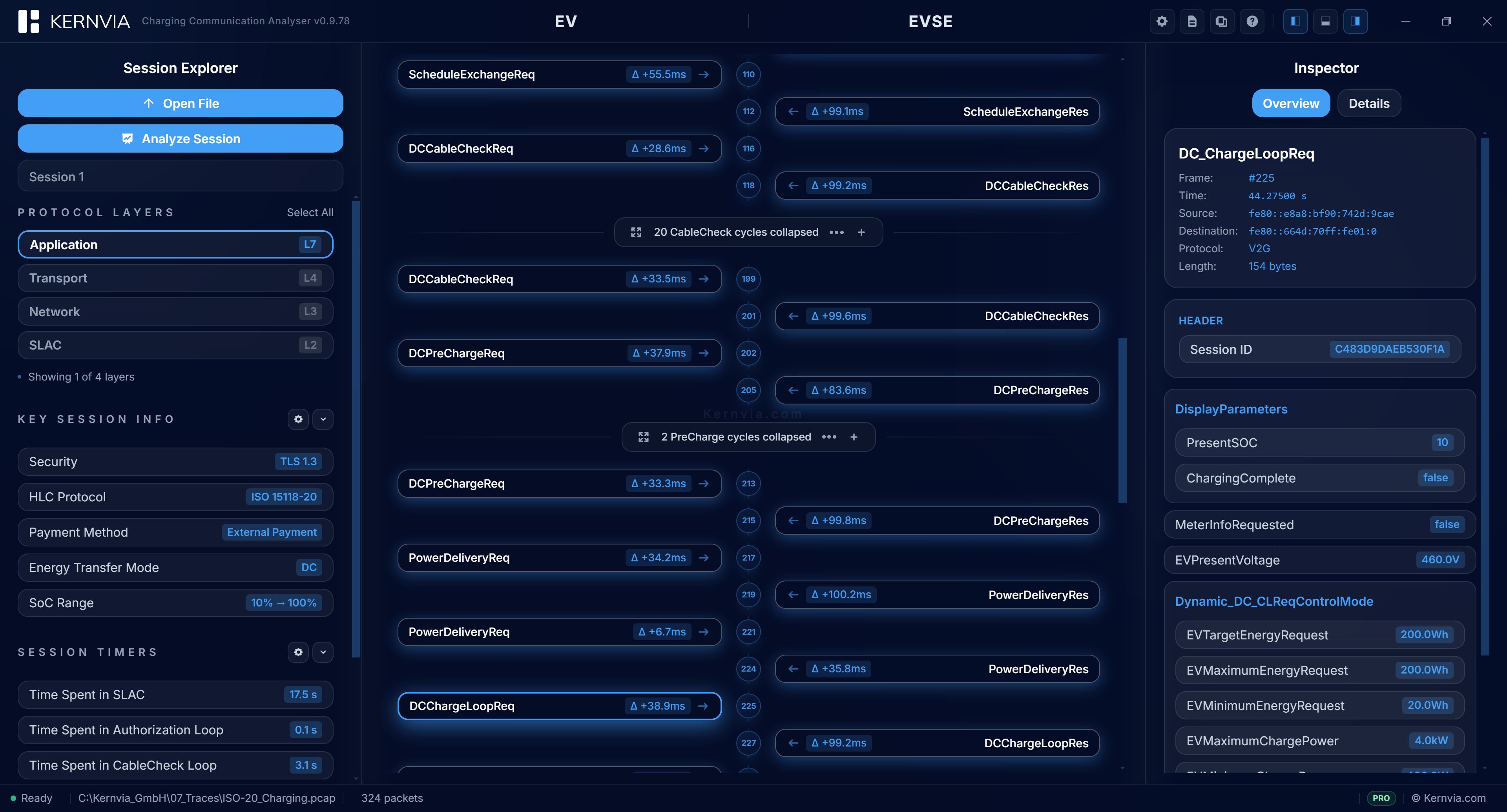
A typical charging session contains hundreds or even thousands of packets. KERNVIA organizes them into a clean, easy-to-read sequence diagram between the EV and EVSE. No more scrolling through endless packet lists to find the message you need.
- Smart Grouping: Repetitive message cycles (CableCheck, PreCharge, CurrentDemand, etc...) are automatically collapsed into single, expandable rows.
- Targeted Filtering: The Protocol Layers Filter isolates specific traffic instantly (e.g., hiding TCP to focus on V2G).
- Instant Timing: Delta timing on every message shows exact response times at a glance, directly in the sequence flow.
One-Click Deep Inspection
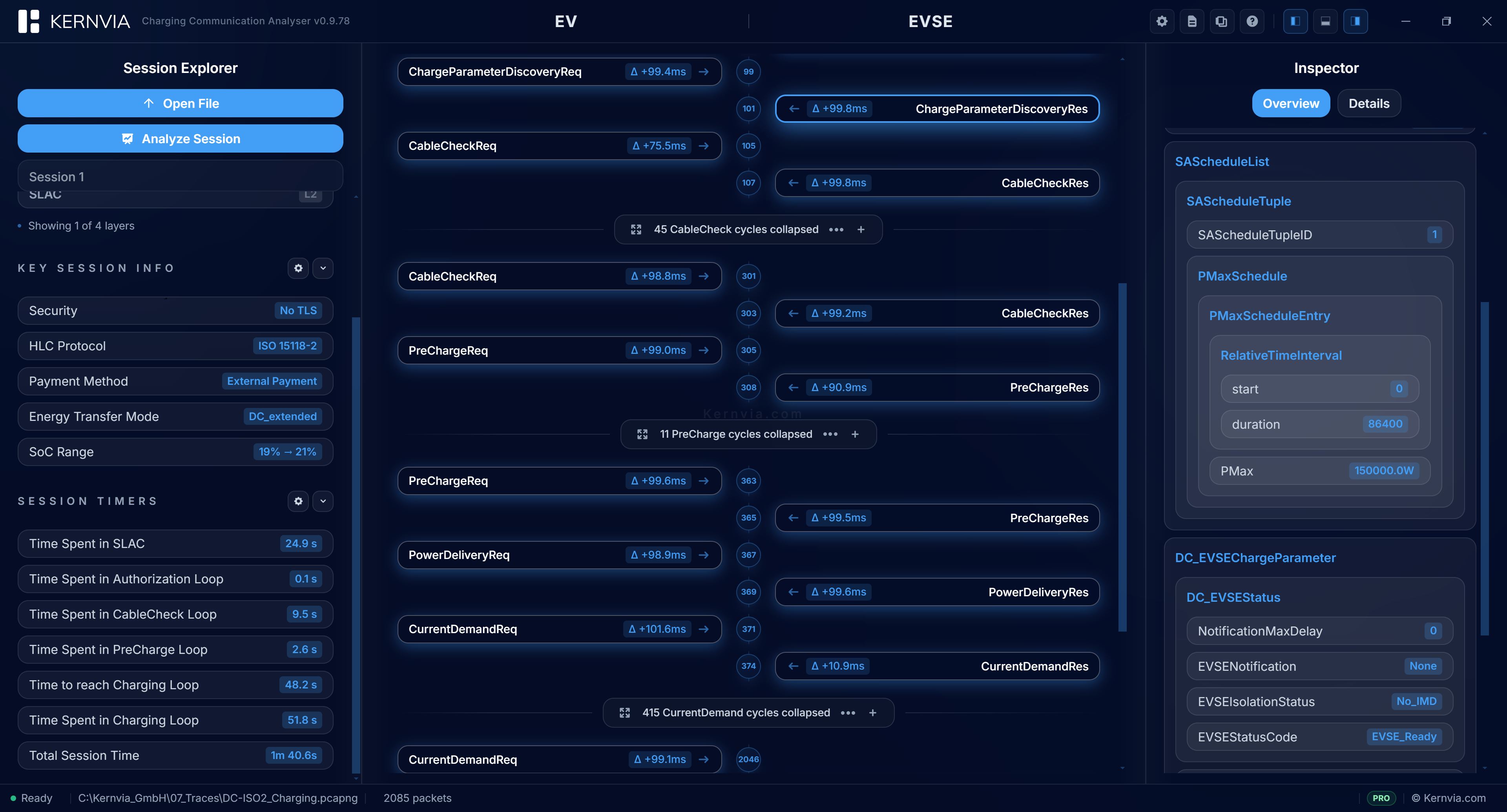
Click any message in the sequence diagram and the Inspector instantly reveals the full decoded payload in a clean, structured layout. No need to drill through nested protocol trees to find a single value. Every V2G parameter is clearly presented, saving you from tedious manual searching.
- Flat Payload View: All decoded message fields are presented in a highly readable, card-based layout instead of the deeply nested protocol trees found in traditional network analyzers.
- Instant Session Overview: The Key Session Info and Session Timers panels automatically surface vital data, giving you an immediate feel for how the session went.
- Unified Workspace: Every detail is one click away. Select a message and the Inspector updates instantly, keeping your protocol layers, session context, and payload data visible in a single, focused view.
Automated Root Cause Analysis
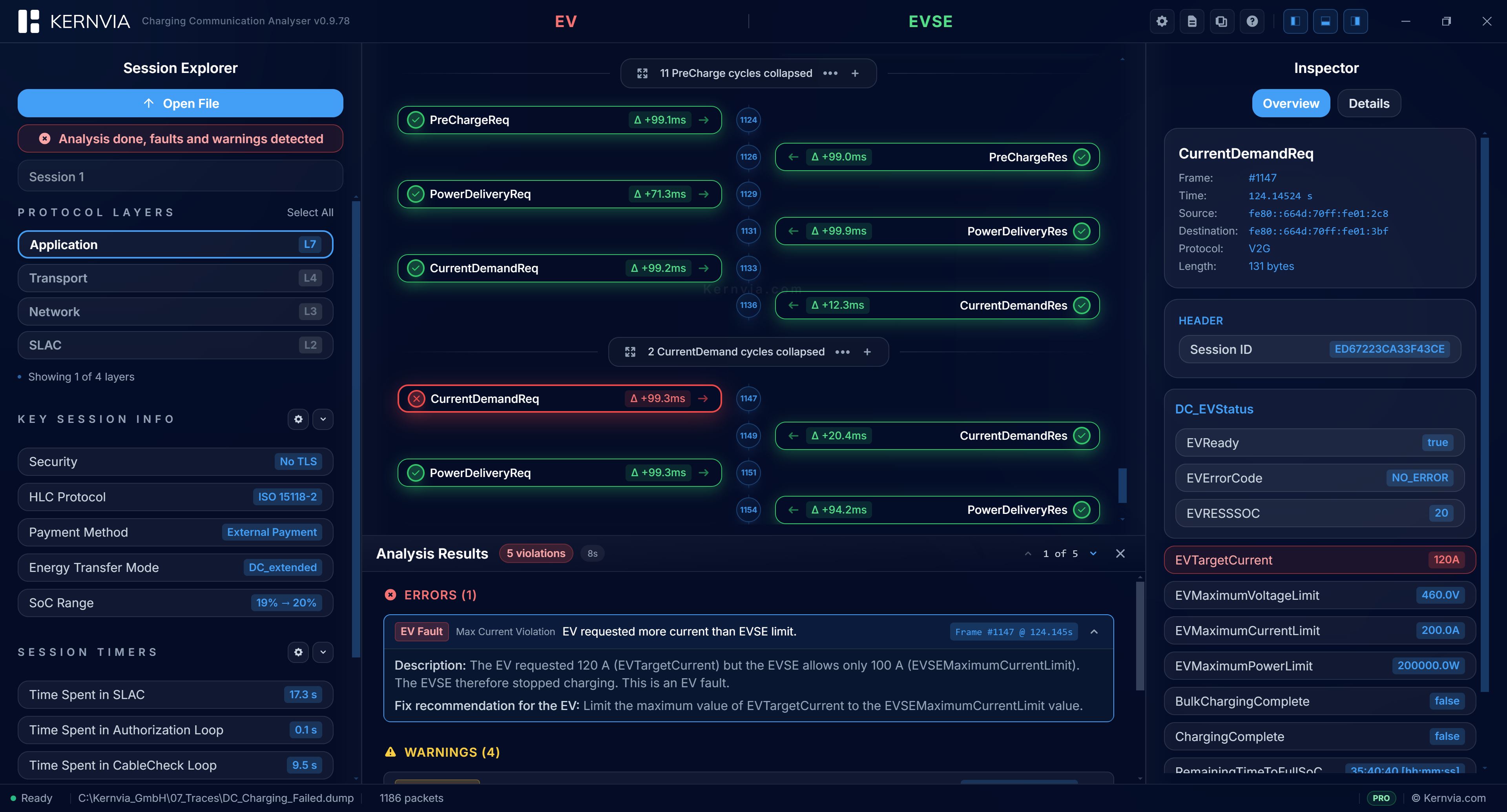
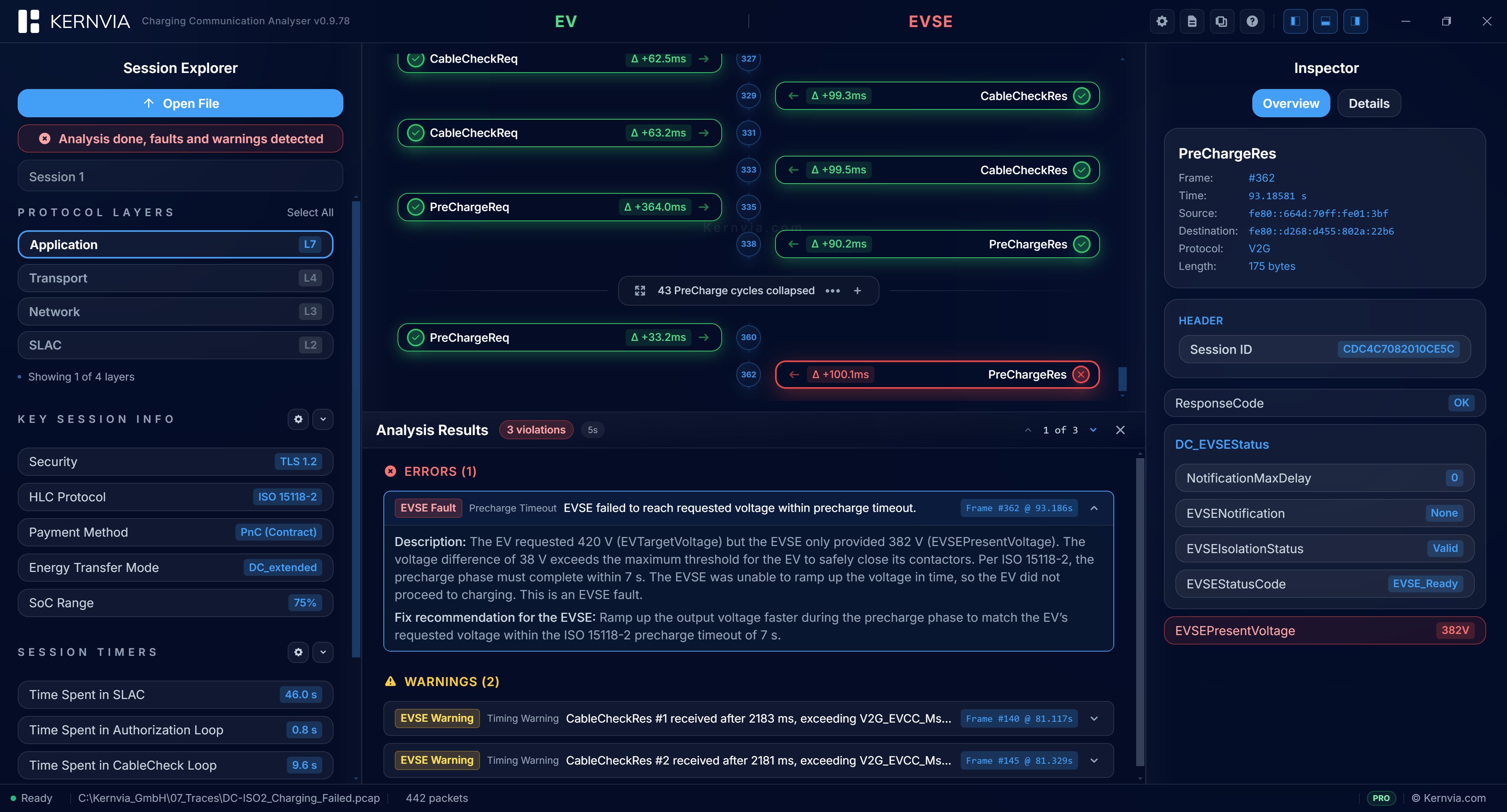
Every charging session is automatically validated against the strict requirements of the applicable standard. When the analyzer detects a violation, it generates a clear warning or error with a detailed description and a specific fix recommendation.
- Comprehensive Validation: Per Session validation against DIN 70121, ISO 15118-2, ISO 15118-3, and ISO 15118-20 requirements.
- No-Jargon Explanations: Plain-English descriptions explicitly explain exactly what went wrong and why, eliminating the guesswork.
- Definitive Fault Attribution: Instantly ends the "blame game" by explicitly identifying whether the EV or the EVSE caused the failure.
Automated Timing Validation
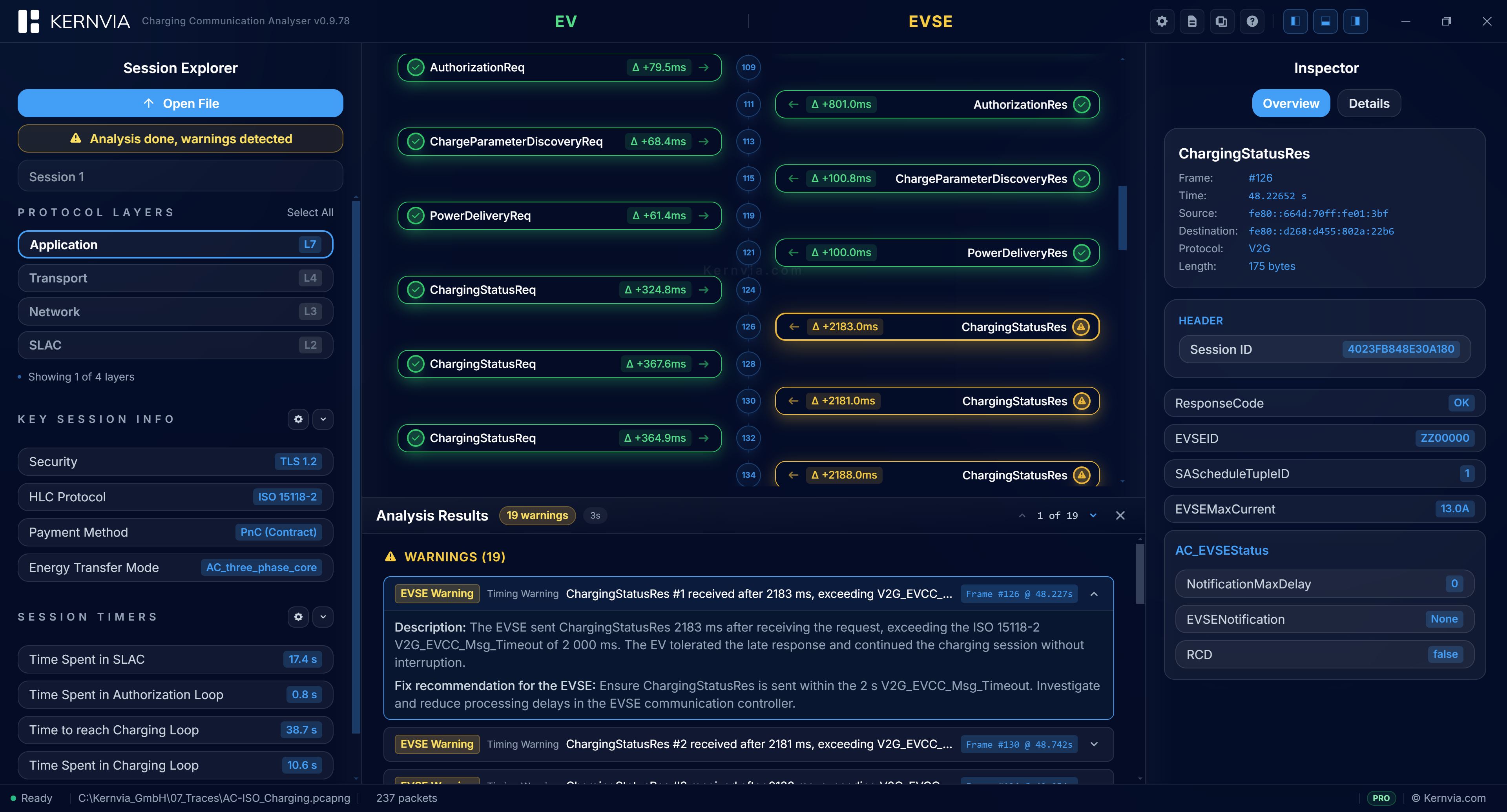
DIN 70121 and ISO 15118 define strict timeout limits, and a deviation of just a few milliseconds can cause a session to silently fail. KERNVIA automatically verifies every response time and cycle time against the standard’s requirements, flagging performance violations and timeout errors instantly.
- Automated Timeout Detection: Instantly detects and flags response time violations, cycle time limits, and sequence timing issues.
- Phase Performance Tracking: Break down exactly how long each phase took, from SLAC initialization to active charging to pinpoint bottlenecks.
- Silent Failure Diagnostics: Easily catch the subtle, intermittent millisecond deviations that cause otherwise compliant chargers and vehicles to drop sessions in the field.
TLS, Certificates & PnC Validation
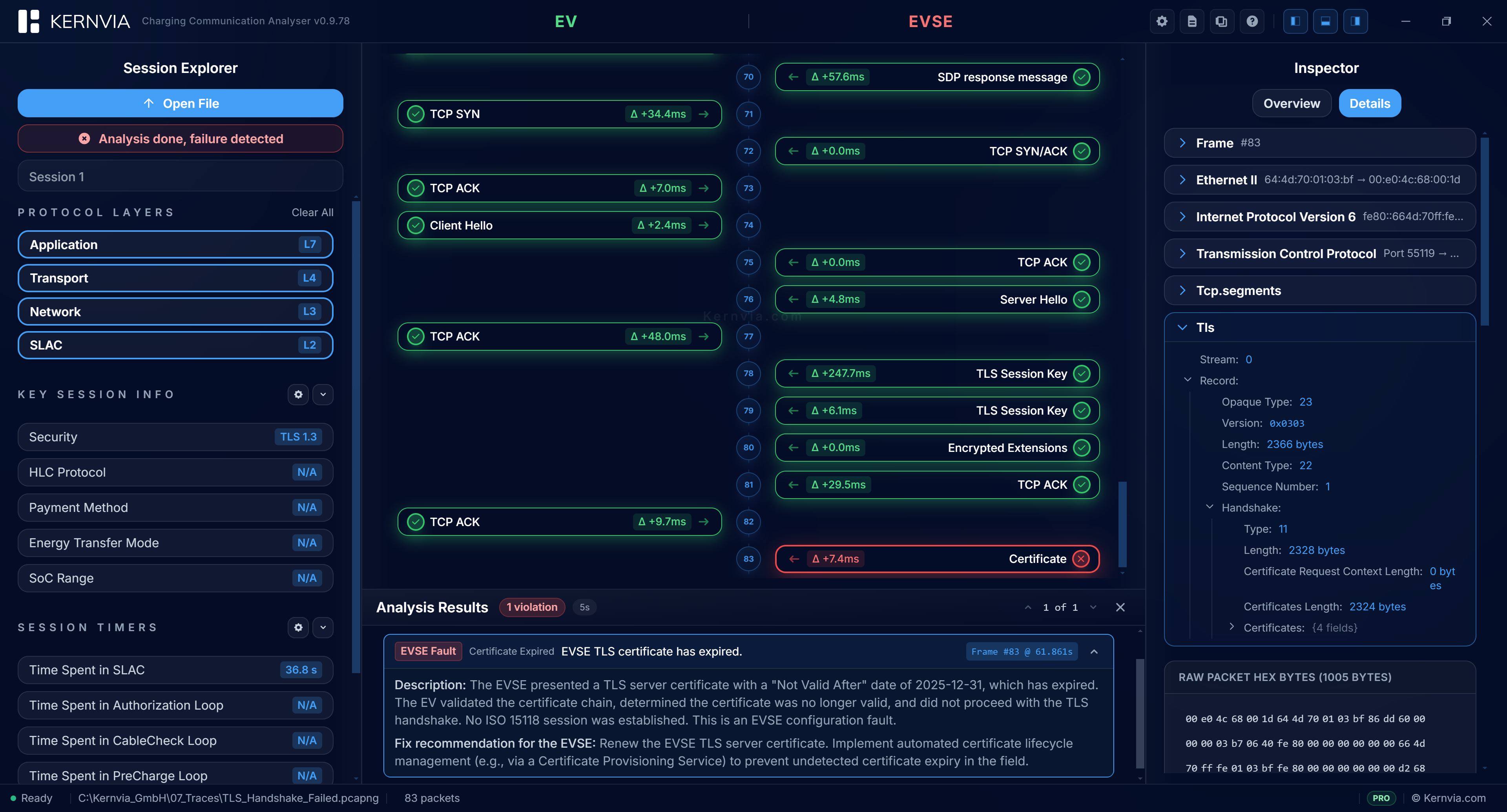
KERNVIA checks the complete TLS handshake and Plug & Charge (PnC) sequence, validating them directly against IETF RFC and ISO 15118 requirements to instantly identify why they failed.
- Transport Layer Security Analysis: Validates TLS 1.2 (RFC 5246) and TLS 1.3 (RFC 8446) handshakes, checking cipher suites, key exchanges, and cryptographic parameters.
- Plug & Charge Diagnostics: Automatically detects expired certificates, invalid trust chains, and signature mismatches that break PnC contract authentication.
- Deep Hex Inspection: Access raw packet hex bytes directly in the Inspector for deep-dive analysis of certificate payloads and handshake data.
More Capabilities
Batch Processing and Regression
Stop opening PCAP files one by one. Drag and drop entire folders of charging sessions to get an instant Pass/Fail dashboard. It is perfect for regression testing, allowing you to instantly verify if a new firmware version has improved or degraded performance.
The analyzer aggregates the data to show success rates and average timing, helping you catch intermittent “flaky” errors that single-trace analysis often misses.
Compliance Reporting and Referee
When a charger and EV disagree, KERNVIA provides the definitive proof. Generate a professional PDF report that acts as an objective referee, pinpointing the specific DIN 70121 or ISO 15118 violation that caused the failure.
It’s the perfect attachment for Jira tickets or supplier emails. Instead of sending raw log files that vendors ignore, send a clear, standard-based document that forces a resolution.
100% Local and GDPR Compliant
Your R&D data is your intellectual property. KERNVIA runs entirely on your local machine. No cloud uploads, no external servers, and no third-party data processing.
Analyze sensitive traces containing confidential information or unreleased features with total peace of mind, fully satisfying strict corporate IT security and GDPR requirements.
About Us
Kernvia is a German automotive software startup specializing in electric vehicle charging communication interoperability.
The company was founded by a senior software engineer with 17 years of automotive R&D experience, including 8 years dedicated to electric vehicle charging communication and ISO 15118 at Mercedes-Benz and Porsche Engineering. Having experienced the industry-wide bottlenecks of manual protocol debugging firsthand, Kernvia was built to solve this exact problem.
Our mission is to replace manual, time-consuming error analysis with instant, automated insights, accelerating EV interoperability and making public charging reliable for everyone.
Supported by the Regional Startup & Innovation Ecosystem
Ready to solve your Charging Interoperability challenges?
Request beta access for our tool, or reach out to discuss how our expertise can support your specific charging communication projects.